Friday, 5 October 2012

Neome Goudal***

Neome Goudal


" Noemie recreates small episodes from people's lives. Some are based on their fantasies and others draw on their personal experiences. But what is common to all her work is Noemie's ability to translate these anecdotes into a visual language using the narrative properties of the photograph to convey more than a literal document.
Noemie began taking pictures as a young teenager in her grandmother's garden, where she would ask her sisters to dress up in costumes and play a role for the camera. She went on to study graphic design at college but when reviewing her final portfolio she realised that it was full of photography and stopped pursing a career as a designer and applied to St Martin's College in London to study photography.
Her talent was quickly recognised when she won the photography prize at Central St Martins, the D&D Student of the Year Award in 2006 and also in the same year being awarded a merit in the Fujifilm competition.
She has been exhibited internationally: her series of Louis Vuitton sponsored Christmas window displays in Hong Kong; at the D & D New Blood show in London, 2007 and her series "Les Roses de Veules" in France.
Since graduating from the Royal College in 2010 Noemie Goudal has become one the most successful emerging artists of her year.
Picked up by the Caitlin Prize and Saatchi's New Sensations for her final degree show series "Les Amants", Noemie has gone on to exhibit internationally in Milan, Paris and New York and in London.
For her latest solo show at Edel Assanti, London she presented new work "Haven Her Body Was", which will also be shown at Project B in Milan in September.
In 2011 she was awarded the inaugural artist in residence at the Corinthia Hotel in London and an exhibition of the project will be shown during April 2012 at the hotel.
Noemie was selected for the 2012 Photo50, curated by Sue Steward and will also be included in the forth coming survey show of contemporary photography "Out of Focus", which opens at the Saatchi Gallery on the 25th April.
Her work is held in the collections of the Saatchi Gallery, Winterthur Fotomuseum and Conran Foundation."                  
       
(http://www.troikaeditions.co.uk/artists/noemie-goudal)


WWWWWH?

Who?

What?

Why?

When?

Where?

How?

Yet to be realised, image received, sent and justification


Above is the image I received by email from Schnel. I spent some time studying this image after receiving it, trying to unpick the scene and understand what is happening within the frame.
I noted the board game being played is monopoly so decided this was on possible route for developing the story.

I considered focusing more on the people and their actions that would follow the ones capture above. However i decided to change the view point of the people in the scene, paying particular attention to the laughing expression. This interested me as there isn’t really any aspect or monopoly that results in such amusement. 
From this I figured I could create a more witty, light hearted and playful image which allows the net person in the chain (Kieran) to interpret the image and completely shift the meaning of the series.


I set up a game of monopoly in my room and chose a random ‘Chance’ card. which I then held in front of me and photographed from a realistic view point.
I used a low aperture to achieve a shallow depth of field.
I was sure to shoot in the same format as the image sent to me also. 
The image below is the one I chose to edit as the one with the legs I thought was too suggestive. and the others didn’t reveal as much of the board, I wanted the money and dice to be visible as to increase the chances of development on the behalf of the person as well as not have to limit him or control his interpretation of the sex of the person holding the image. This was purposely intentional as i thought it would be interesting if he was to create the next scene but shift the subject matter and maybe interpret a different gender being involved in this sequence.


After selecting the image I thought was best composed and technically most appropriate and strongest I used photoshop to slightly crop the image to make the proportions similar to those of the image I received and converted the image to black and white. I slightly increased the contrast, again to keep in visual relation the one which I had received. 
I then used the clone tool to cover up the text which was on the card originally. I found a font as similar to monopoly font as i could and used the text tool, along with the move and rotate tool to perfectly position the new text. Above it the final image I passed on.
I thought it would be interesting to see how Kieran, a male interprets this and how he may consider the perspective and the person who could be reading this card after having “endured” a dinner party.

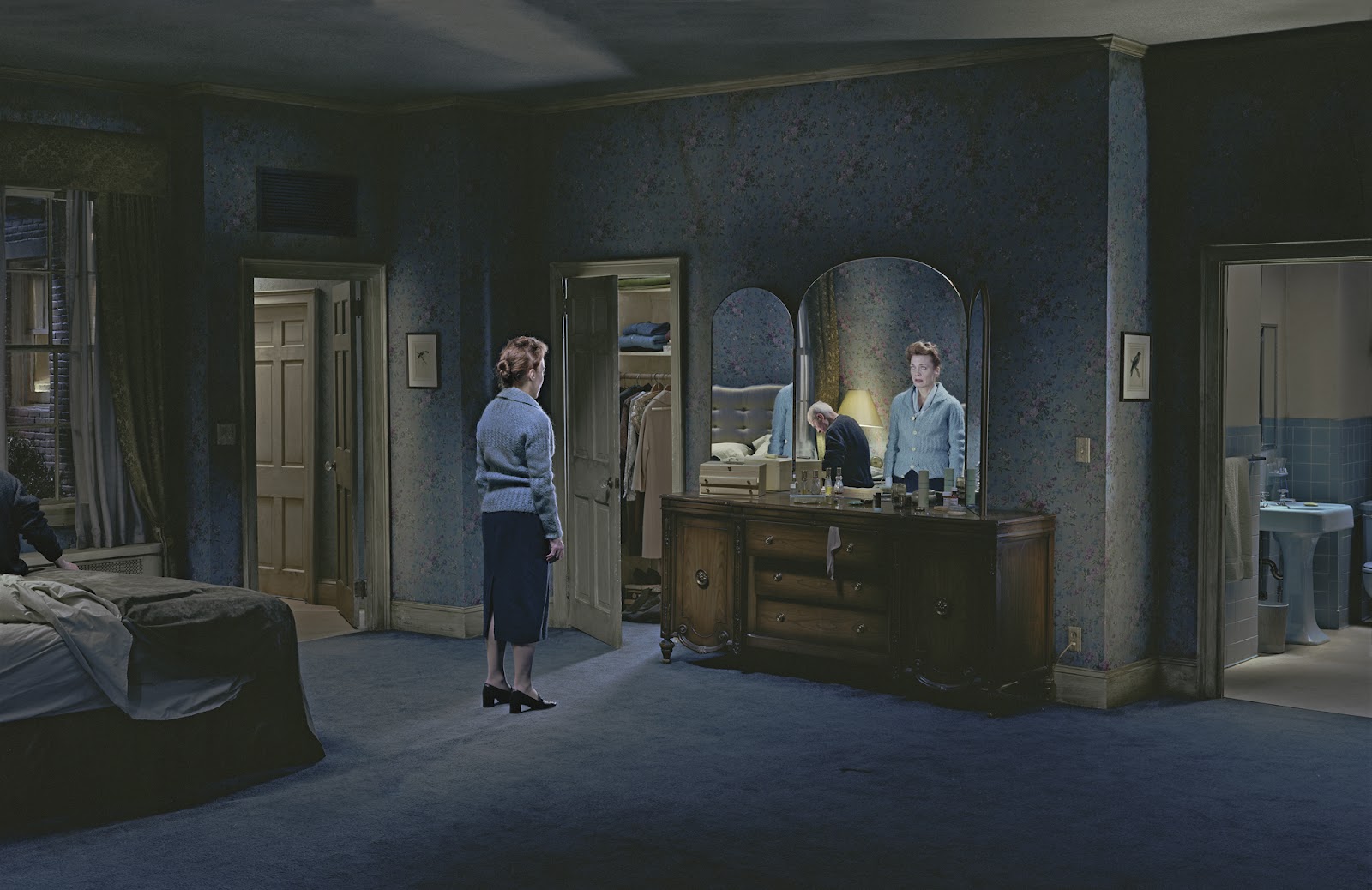
Susan Bright on Gregory Crewdson

“The sinister and seething underbelly of suburbia has long been a source of inspiration for artists. Built as aspirational and almost paradisiacal habitats for the middle classes, these areas outside of the city centre become, for American artist Crewdson, sites for bizarre and unexplainable happenings. Tapping into a host of paranoid fears, it is as if the lid has been lifted to expose the fantasies and anxieties of those living there. The almost claustrophobic calmness of the inhabitants in his tableaux contradicts the activities around them, causing an uncanny tension that we, as viewers, understand and react to like the moment before a catastrophe in a science-fiction film." (Susan Bright, Art Photography Now P.80)

I have typed up the text from my book and would like to refer particularly to her comment on the work being 'uncanny'. This is something i completely relate to when viewing Crewdson's images. The scenes are so familiar, yet captured in a way we feel we have never seen for longer than split second when the lighting is just perfect and the expression of a person takes on the unfamiliar. To me, his work is so effective as it freezes these 'freak' sporadic moments and allows us to absorb it for much longer.

More images and my thoughts on Crewdson


More images and my thoughts on Crewdson


I find it extremely difficult to string together the words to justify the work of Gregory Crewdson. 
His pictures, frequently showing any old American town, any old mundane everyday scene, somehow create an immense sense of atmosphere in a single frame. The present the everyday in a fresh light, intact there is something relatively uneasy about the images, yet i can't quite pin point what it is, the unusual saturation and contract of colours, the overall sharpness and detail in every element of the photograph.
There is something in the cinematic aesthetics of the photographs which is almost uneasy and relatively dream like to me.
The mood created is so intense and surreal, yet relatable to the extent that the viewer becomes part of the story, or at least we certainly feel part of the narrative told in the frame. His work is, in a way fairly eerie. His style is easily identified, there is particular 'look' that no other photographer seems to have 'mastered' in such a powerful way.
I think the images attain the power to leave a lasting impression on the mind long after seeing them, they certainly leave a permanent stamp on my mind
There is also the element of the images that make split seconds in everyones days seem picturesque like the images, moments when the light filters through the trees in a certain way, moments when then mundane takes on the qualities of 'eerie' i see in Crewdson's work. 


Gregory Crewdson - Text from Charlotte Cotton


I looked in my book "The photograph as contemporary art" as my initial starting point for researching some of the photographers mentioned in relation to this brief, the below extract is typed up, word for word as it appears on pages 67-68 in the book, written by Charlotte Cotton.

“American artist Gregory Crewdson (b. 1962) has said that his elaborately constructed melodramas are influenced by his memory of childhood. His psychoanalyst-father’s office was in the basement of their New York City home, and Crewdson would press his ear to the floorboards to try and imagine the stories being told in the therapy sessions. In the mid1990s, Crewdson’s tableau photographs were set in models of suburban backyards and undergrowth built in his studio. They are a mix of the bizarre and the disturbing, yet are so highly camp and entertaining. Stuffed animals and birds perform strange and ominous rituals, while plaster casts of Crewdson’s body are shown being slowly devoured by insects, surrounded by lush foliage. Crewdson later shifted into a more directorial mode. In his black-and-white series Hover (1996-97), he staged strange happenings in suburban housing areas, photographing them from a crane above the rooftops. More recently, in his Twilight series, he worked with a cast and crew of the kind found on a film set. Here it is not only the display of rituals and the paranormal but also the construction of archetypal characters who carry out these acts that create the psychological drama. Significantly, at the back of the book about the Twilight series is a ‘documentary views’ section that shows the entire production process, the crew members, and the moments before and after a photograph is taken, confirming the degree to which Crewdson’s tableau photography is a production issue.”

(The Photograph As Contemporary Art by Charlotte Cotton, p.67-68)


The image below is the example that accompanied the above text in the mentioned book.        


As soon as i saw the above image, i was reminded of an image by Tom hunter (see below)


I remembered that Tom Hunters work, this image in particular was a recreation of a famous pre-Raphaelite painting  (see below)


The painting by John Everett Millais  was recreated by Hunter; in a completely modern context. The story behind Ophelia,  is taken from Hamlet. Ophelia who through the death of her father and brother is driven to madness,  and drowns herself. The emotion is meant to be one of not only sorrow but of sympathy; the character of ophelia is presented as one of innocence, reservation and simplicity; her madness was something bought on by her irrationality and her circumstance. Millais tries to capture this through her expression on her face as she lies in the water; her arms poised in a helpless manner: almost as if to say woe is me. 

Hunter rekindles many of these concepts within his work; but makes the image realistic within the 21st century.  The model is deliberately wearing “modern” or clothing synonymous with the 21st century. One of the most powerful elements of this image as a modern recreation, is the train bridge in the background; although very subtle, it completely changes the context of the image, and brings the scene ‘back to reality”. The emotion in Ophelia’s face and expression has been removed by hunter; here he composes her almost as if she is dead: pale and motionless. This brings to mind the element of a sinister death as opposed to a sympathetic peaceful one.

Thinking about Hunter, and his recreation, who i am thankfully so familiar with due to research for a previous assignment last year, I would imagine Crewdson was too, inspired by John Everett Milliais's painting.


Monday, 1 October 2012

circular narrative


"Starting from the top for example, I read a letter to myself from myself, and am instructed to send it to myself. I then put it in an envelope and stamp it, I post it, I wait for it to be delivered, it gets delivered, I open the envelope, and the cycle starts again. My visual influence was from the book Envelopes by Harriet Russell, in which she sends herself many envelopes with cryptic clues for the postal staff to work out where to send them!

My reading of a circular narrative was that the narrative kept repeating itself, like a circle; there is no start or end. If photograph 1 and 6 are the same, then the circular flow it interrupted by two identical images side by side. I hope this is making sense to someone as I seem to be the only one thinking this today! "