In uni today we watched La Jetee, I decided to look into this further and came across a blog where someone had writhed in detail about La Jeete and similarities between a novel titles Dictee.
I found this really interesting to read and it helped my understanding of the film viewed today in class.

There is no future, only the onslaught of time.
Theresa Hak Kyung Cha’s Dictee (NY: Tanam Pres, 1982) is an experiment in autobiography that blends poetry and prose, history and memoir, and reproductions of photographs and documents. Many of Cha’s themes overlap with those found in the work of W.G. Sebald: history, memory, war, cruelty, family.
To the other nations who are not witnesses, who are not subject to the same oppressions, they cannot know. Unfathomable the words, the terminology: enemy, atrocities, conquest, betrayal, invasion, destruction. They exist only in the larger perception of History’s recording, that affirmed, admittedly and unmistakably, one enemy nation has disregarded the humanity of another. Not physical enough. Not to the very flesh and bone, to the core, to the mark, to the point where it is necessary to intervene, even if to invent anew, expressions, for this experience, for this outcome, that does not cease to continue.
To the others, these accounts are about (one more) distant land, like (any other) distant land, without any discernable features in the narrative, (all the same) distant like any other.
But Cha adds additional layers: Catholicism and feminism. Dictee opens with Communion, followed by confession, and it closes with a scene embodying acts of charity (water, medicine, advice) between a woman and a young girl. Overseeing Cha’s enterprise are the nine classical Muses, the daughters of Zeus and Mnemosyne (memory) who presided over the arts and sciences. Each of Dictee‘s chapters is assigned the name of a Muse. The history that Cha probes is the story of twentieth century Korea (where her family originated): the Occupation by Japan as a result of the Sino-Japanese War; the country’s division into two parts as a result of the Cold War; and the violent student demonstrations of the 1960s.
But Cha’s main concern, it seems to me, is human communication itself. Dictee (the dictation) is structured as an unending struggle to move from inarticulateness to utterance. Words become syllables, sentences become strings of single words, continuity is disrupted. Where, Cha seems to ask, does language become meaning? Parts of the book are written in French and there are many references to the issues of translation and multilingualism.
Dictee is heavily influenced by film theory. It contains abrupt jump cuts, makes powerful use of vantage point, and dwells on the intellectual dichotomy of listening to spoken language while reading sub-titles in a different language. Following the lead of Michel Butor and other French writers of the nouveau roman, Cha sometimes moves into second person in an attempt to obliterate the boundary between reader and subject.

Her movements are already punctuated by the movement of the camera, her pace, her time, her rhythm. You move from the same distance as the visitor, with the same awe, same reticence, the same anticipation. Stationary on the light never still on her bath water, then slowly moving from room to room, through the same lean and open spaces. Her dress hangs on a door, the cloth is of a light background, revealing the surface with a landscape stained with the slightest of hue. Her portrait is not represented in a still photograph, nor in a painting. All along, you see her without actually seeing, actually having seen her. You do not see her. For the moment, you see only her traces.

More than once, as I read Dictee, I was eerily reminded of Chris Marker’s 1962 film La Jetée.
A decade ahead of Sebald, Cha interlaced her text with uncredited news photographs, portraits, reproductions of documents, and even reproductions of what appear to be the handwritten manuscript for the pages of Dictee.
Theresa Hak Kyung Cha was born in Korea, but raised in the US. After studying at the University of California, Berkeley, she studied filmmaking and critical theory in Paris. A week after Dictee was published, she was murdered by a stranger on the streets of New York. Tanam Press was an important publisher of avantgarde art titles (Jenny Holzer, Reese Williams, Philip Glass, Werner Herzog, Richard Prince) from 1980 to 1986

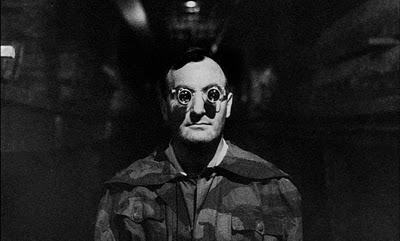
Constructed almost entirely from black and white stills, Chris Marker creates the science fiction film, La Jetee.
I think this piece of work is very successful at holding the viewers attention for such a long period of time. (below have included some stills from the movie which i watched online then used the screen capture feature to collect some of the still moments)


"I written several times before about some of the parallels I see between the art of W.G. Sebald and Chris Marker. Recently, Afterall Books began issuing a new series of books (distributed by MIT Press), each of which is based on a single work of art, such as Hanne Darboven’s Cultural History, 1880-1983 (owned by the Dia Foundation) Yvonne Rainer’s The Mind Is a Muscle, and Marker’s La Jetée. Reading Chris Marker: La Jetée byJanet Harbord only convinced me further that their work has much in common.
As Harbord notes, La Jetée “tells the story of a man marked by an image rather than a memory.” This is a pretty good description of Sebald’s enterprise of discovering the history he did not experience through images, object, and walks; and this seems particularly true of Austerlitz, in which Jacques Austerlitz tries to uncover a family history he that had been kept from him most of his life.
The broken statues and half-demolished buildings that populate many of La Jetée‘s images suggest the very incompleteness of both experience and memory. At the same time, this sense of incompleteness “allows our own supplementation, our own interpretive creations, to take root.” Sebald, whose real topic can be said to be history, turned to narrative fiction precisely because he felt that only an act of the imagination could bring us closer to experiencing other times and other people’s lives. Not surprisingly, the characters in Marker’s film and Sebald’s books frequent museums. The museum provides each artist with a complex commentary on the tangled relationship between history and the artifice that is memory. It serves as both a starting point in one’s exploration of the past, as well as a dead end.
When Harbord writes of Marker’s work on Alain Resnais’ 1955 Holocaust film Night and Fog, she notes that “the [film's] narration articulates questions of memory as place…Place is the retainer of traumatic memory if we know how to look.”
In one of the final images of the film the camera moves across the surface of a ceiling in a chamber. The narrator says this: ‘The only sign – but you have to know – is this ceiling, dug into by fingernails.’ The sentence hangs in the air in its ambiguity, or its fullness of meaning – ‘you have to know’ inferring that you need to be told for the nail marks to become legible….you need to bear this knowledge from the past. The question of what we can bear to know of the past, and of what this means for the future, is laid before us in this moment. At the centre of this circle of questions is the place of images, their ability, or not, to retain and pass on ‘facts’, trauma and meaning – in short, to deal with the ineffable.
This, of course, was the challenge for Sebald and it remains the challenge for us who try to come to grips with the success or failure of this aspect of his work. Can evidence ever become experience? The quote from Harbord immediately above reminded me of the ending of Austerlitz, where Sebald refers to another book – Dan Jacobson’s Heshel’s Kingdom. Here’s what I wrote previously:
Toward the end of Heshel’s Kingdom, Jacobson comes across evidence of a totally different kind. This is evidence left by Jewish prisoners being held in the infamous Fort IX in Kaunas, originally designed to protect the country from invaders, but used by the Nazis to terrorize and eliminate Lithuanian and European Jews. It is with this event that Sebald ends his book Austerlitz. In the bowels of the fort, where many thousands of Jews from all over Europe were held, tortured, and slaughtered, Jacobson comes across names and dates scratched into the walls between 1941 and 1944. “Max Stern, Paris, 18.5.44″, one says. Another reads “Nous sommes neuf cents Francais.” We are nine hundred Frenchmen. As evidence, these stark scratchings seem minor in comparison to the visible horror of the photographs Jacobson has seen, but he suggests that these simple attempts to be remembered, to be human, have a chilling veracity and authenticity far more powerful than documents made by the killers of these same people.
I was mesmerized watching Chris Marker’s two films La Jetée and Sans Soleil on DVD last night. It wasn’t long before I realized there are fascinating connections between Marker’s films and W.G. Sebald’s books. La Jetée (1962) is a photo-roman, the cinematic version of a photo-novel, constructed entirely of haunting still photographs and a single voice-over which relates the story. The circular narrative involves a young boy who, upon visiting Orly airport to see the planes with his parents, witnesses a death and becomes fixated on his memory of the event. Years later when Paris and presumably much of the world is annihilated by atomic warfare, the man’s obsessive memory link to this pre-apocalypse event makes him an ideal candidate for involuntary time travel experiments, conducted by his captors, who hope to discover a way to acquire medicines and supplies from the past or the future. (The conquerors speak in untranslated German, and its hard not to compare their pseudo-medical experiments with those conducted by the Nazis.) Over the course of repeated trips to pre-apocalypse Paris, the man ultimately discovers that it is he, the time-traveler, who is killed on the jetée of Orly airport to the everlasting horror of himself as a child.
Nothing tells memories from ordinary moments. Only afterwards do they claim remembrance on account of their scars.
Even though La Jetée is a post-apocalyptic sci-fi film (and the basis for Terry Gilliam’sTwelve Monkeys), it is, like the work of Sebald, deliberately antiquarian. The film seems longer than its brief 19 minutes length. Marker’s use of still images gives it the rhythm of a slide show (while reminding us of the early films of the Lumière brothers), but the pace also results from the fact that the film is visually rich and densely allusive. There’s just a lot to look at and multiple directions to explore before the next image appears. Although I didn’t catch this the first time through, La Jetée is an homage to Hitchcock’s 1958 film Vertigo. And this, to my mind, brings things full circle back to Sebald. Marker and Sebald are both artists whose works are structured around the ideas of history, memory, nature, ritual, apocalypse. For me, some of the most evocative scenes inLa Jetée occur in a natural history museum, redolent of the narrators in Sebald’s books who wander through museums and zoos. The man (and the woman he falls in love with during his time-travels to pre-apocalypse Paris) views the melancholy beauty of the twice-dead bestiary, for he alone bears the knowledge that these dead and stuffed animals are soon to become extinct as species."
(http://sebald.wordpress.com/category/chris-marker/)


